Copyright © 2024 Peking University School of Transnational Law.

The LLM program structure at Peking University School of Transnational Law (STL) is characterized by diversity and flexibility. Students can pick the courses, timeline and extra-curricular activities that best foster their academic interests and career goals.
The curriculum is designed to train lawyers who are comfortable working between multiple jurisdictions and different types of law and able to tackle complex and contemporary issues. STL offers the most extensive selection of English-language coursework of any law school in China, with more than 70 English-language courses covering subjects from international and comparative law to Chinese law to American common law. The curriculum includes a wide selection of specialty topics and electives ranging from Traditional Chinese Legal Thought to International Fintech Regulation.
STL is also one of the only law schools in the world where international students can take law courses in both English and Chinese. Additionally, STL offers one of the only LLM programs in China where international students study alongside their Chinese colleagues in nearly all their courses.
Whether you are a fresh graduate seeking specialized legal training, international experience and adventure, a mid-career professional ready to earn the credentials to promote your position or transition your field, an ambitious scholar excited to research in new fields, or even a partner at a law firm looking for opportunities to expand your network in China, STL’s LLM program can fit your goals.
01
Our LLM program can be completed entirely in English. Indeed, STL has the most diverse and extensive English language curriculum of any law school in China, offering more than 70 different courses in English. However, the program will also provide international students the opportunity to study the Chinese language, and even take law courses in Chinese if they have the requisite proficiency.
02
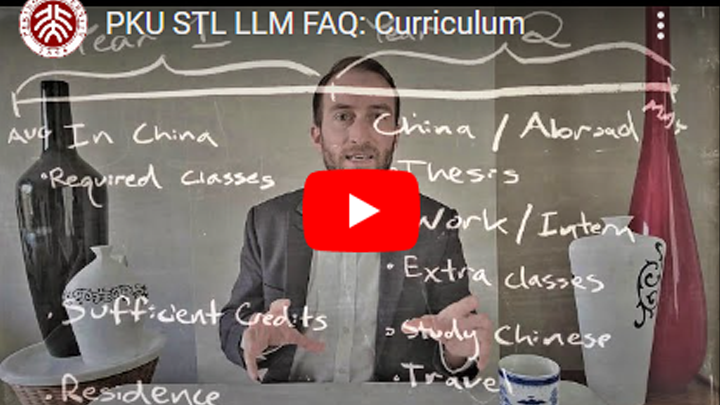
STL’s LLM is a two-year program. However, students can complete all the required courses and sufficient credits to graduate in one year. The main requirement during the second year is writing a thesis paper. Students can choose to return to their home country during the second year and write their thesis remotely. Alternatively, LLM students can remain in China during the second year and participate in a range of activities including: taking additional law courses, taking business courses at PHBS, studying Chinese, doing an internship or externship, competing in moot court, serving as a research assistant, or traveling.
03
STLs academic year runs from mid-August to early July, with a month-long mid-year holiday for the Chinese Spring Festival in January/February. For details about the current academic calendar click HERE.
The academic year is divided into 4 quarters that are roughly 10 weeks each. Students select new courses each quarter and are assessed for those courses at the end of the quarter. LLM students typically take around 4 courses each quarter. This however is flexible. The exact number and type of courses are up to the student. We can advise students individually on what will work best for them.
04
To earn the LL.M. degree, candidates must:
1) Complete a minimum of 42 credits of course work (approximately 15 courses), including the following required courses;
a) China Studies (3 credits)
b) Chinese Language (2 credits)
c) Academic Research and a Writing I (1 credit) and II (1 credit)
d) Transnational Law Requirement (3 credits)
e) Advanced Transnational Law Requirement (3 credits)
f) Transnational Legal Practice Requirement (3 credits)
2) Draft a thesis paper (6 credits) on a topic of the student’s choice.
3) Spend at least three academic quarters in residence.
05
In addition to completing LLM coursework during the program, students can participate in a wide range of additional activities for-credit and not-for-credit.
| For-Credit Activities: | Not-For-Credit Activities |
|
- Moot court - Externships - Law review - Chinese language study through Peking University - Study abroad at partner institutions worldwide |
- Internships - Research and teaching assistantships - Chinese language study with a tutor or at a language school - General education courses such as painting and Chinese calligraphy - Recreational and competitive sports - Student organisations and clubs - Campus events, festivals and cultural excursions - Community volunteering and community-based projects - Academic innovation competitions - Career fairs and employer information sessions - Visits to Chinese companies and law firms |
06
All students earn the same LL.M. degree. After enrolment, you may choose to pursue a concentration. If you complete 12 credits of coursework in your chosen field and write your thesis in that field, you will receive a Certificate of Concentration alongside your LL.M. degree.
The five concentrations are:
1) Intellectual Property (patents, trademarks, copyright and IP enforcement);
2) Corporate & Commercial (company law, finance, securities and transactions);
3) International Arbitration & Dispute Resolution (cross-border disputes);
4) Law & Technology (data, artificial intelligence and digital regulation);
5) Public International Law (relations between states, international trade and global governance).

07
An important feature of doing an LLM for many students is building some international work experience. Through STL’s LLM, students have a range of opportunities to intern and work in China. These can be for-credit or not-for-credit, paid or unpaid, during the program or after the program. Such opportunities are competitive and merit based. STL has a dedicated career services department that can help LLM students find internships and jobs.