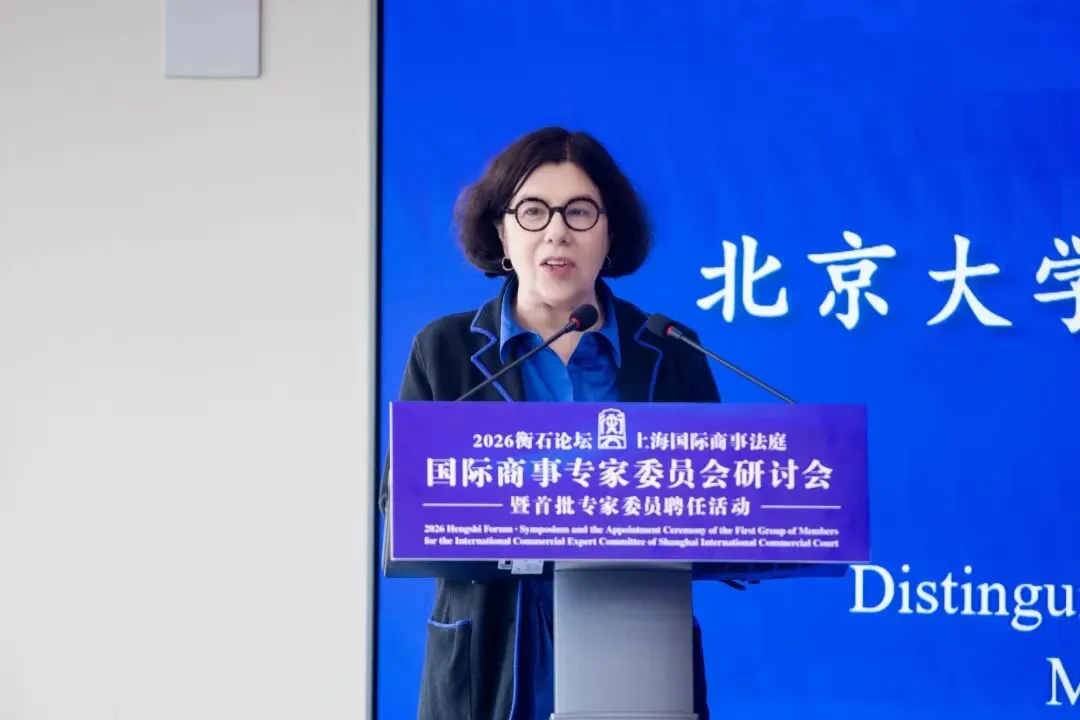
Recently, the Shanghai International Commercial Court (SHICC) held its inaugural appointment ceremony for the International Commercial Expert Committee, with 20 domestic and international experts being appointed. Among them is Susan Finder, Distinguished Scholar in Residence at Peking University School of Transnational Law, who also delivered a keynote speech as one of the eight representative experts.
Susan Finder is a renowned scholar in comparative Chinese judicial system studies. She holds a J.D. from Harvard Law School, an LL.M. from Columbia Law School, and a B.A. from Yale University. She currently serves as an expert member of the International Commercial Expert Committee of the Supreme People's Court, and has long focused on the evolution of the Supreme People's Court's role and judicial practices.
In her speech, Finder first noted that since the establishment of the International Commercial Expert Committee of the China International Commercial Court (CICC) in 2018, the participation of foreign expert members still has significant room for growth compared with their domestic counterparts. She emphasized that fully leveraging the unique strengths of foreign experts would not only improve the quality and efficiency of international commercial adjudication but also enhance the court's international credibility and influence. To that end, she put forward three specific suggestions:
First, the SHICC should, based on an in-depth understanding of each foreign expert's academic background, practical expertise, and cultural perspective, design tailored roles for them. For instance, some experts excel in common law evidence rules, others are proficient in international arbitration procedures, and still others are familiar with cross-border M&A practices. The court could invite them to engage in matters, that align their theoretical and practical strengths with the court's needs. Second, the functions of foreign experts should not be confined to traditional case-specific consultations or legal opinion drafting. Instead, their roles should be expanded to include participation in judicial administration improvement, collaborative education with local law schools, and design of cross-border commercial training programs for judges and lawyers. They could even be regarded as a "resident think tank" for the court, engaging in various activities both online and in person. Third, to ensure the implementation of these expanded functions, Finder called for the establishment of an "express lane" for administrative procedures related to foreign experts' visits, exchanges, and participation in court activities. This would streamline visa applications, reporting, and other bureaucratic processes, enabling foreign experts to contribute efficiently and conveniently.